
Some links on this page earn us a commission if you buy after clicking. It changes neither the ranking nor what is written here — and we say below what we were unable to check.
A dog in pain almost never complains. It changes its behaviour, and the people around it put the change down to age or temperament. You do not need to be a vet to see these seven signs.
1. It turns irritable, and that gets called personality
This is the most common sign and the most badly read. A dog that growls when you touch one particular spot, that puts up with children or other dogs less well than it did, is not "getting difficult with age": it is guarding an area that hurts.
The question that points the way: is the irritability general, or tied to a touch, a position, a time of day? Irritability that has a location is almost always pain.
2. It licks the same spot every time
Repeated licking over a joint or a limb is not grooming. It is self-soothing aimed at a painful area, and it ends up creating a visible sore that then gets treated as the problem.
The sore is the consequence. Treating the skin without asking why it licks comes down to erasing the symptom of a symptom.
3. It avoids things long before it limps
No longer getting up on the sofa, hesitating at the foot of the stairs, taking a different run-up to get into the car: these avoidances come several months before the limp.
This is the most useful window to act in, and the one most often missed, because a dog that avoids things shows nothing at all when you watch it standing still.
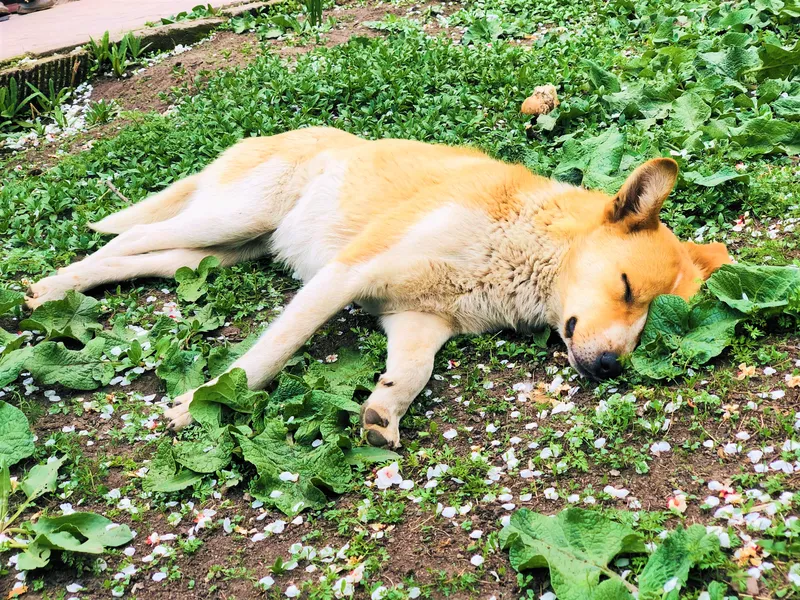
4. Its sleeping posture changes
A dog that used to sleep curled up and now sleeps stretched out on its side, or the other way round, is working around something new. A dog that no longer lies down fully, or that lies down in stages, is protecting something.
This is the easiest observation to make and the least often made, because it asks you to remember how it slept six months ago.
5. It eats more slowly, or only on one side
Dental pain rarely shows itself as a refusal to eat: it shows itself as a different way of eating. Chewing on one side, leaving the hardest kibble, drinking more during the meal.
Dental disease is among the most common and most silent chronic pains in the adult dog.
6. It pants without being hot and without having run
Panting regulates temperature, but it also goes with pain and with stress. A dog panting at rest, in a cool room, after no effort, is not regulating anything.
Together with restlessness or an inability to settle, it is a sign that warrants a call the same day: some abdominal emergencies begin exactly like this.
7. It keeps to itself, or it clings
Both extremes mean the same thing: the dog's relationship with its surroundings has changed. A sociable dog that withdraws, an independent dog that will no longer leave its owner's side, in both cases something has changed.
On its own, this sign means nothing. Alongside one or two others from this list, it becomes a reason to see a vet rather than wait.
What to take from these seven signs
None of these signs tells you what the animal is suffering from, and that is not their job. Their only use is to turn "it is getting old" into "it may be in pain", which changes everything about what you do next.
The practical marker: two signs present at the same time, or a single one lasting more than a week, justify an appointment. Pain caught early costs less than pain that has settled in, for the animal and for the budget.